Life force and the flow of your ribs
The tone and flexibility of your ribs affects your posture, spinal flexibility, breath capacity, organ health and even your mood. Too loose and there’s not enough support, too tight however and you’re stuck.
Many of our Dojiva classes help you to find your maximum yet comfortable three dimensional rib potential and lung space... what Judith Aston calls internal volume.
During a private client’s first appointment (and occasionally thereafter), an important part of my assessment was to palpate the whole body. What I discovered over and over again were tight lower ribs (often around the bra line for a lady). This was usually accompanied with round shoulders, a collapsed upper chest and a tucked under pelvis.
However, with a few sessions of body-work and exercise, tight ribs soon neutralised and the flexed posture disappeared. Also, associated spine and shoulder problems tended to self resolve.
Basic anatomy
We have 10 pairs of ribs to the front (attaching to chest bone) and due to the floating ribs, 12 pairs to the back (attaching to the spine). Collectively their are known as thecalled a cage, this is not rigid like a bird cage and like all our bones, joints, muscles and connective tissues, they are ideally resilient (a combination of buoyancy, flexibility and strength).
So, the rib cage is a key part of overall posture and has many other lifestyle considerations such as:
- Support of shoulder girdle above - If your ribs are too tight or too loose, the shoulders can lack flexibility which affects function for life and sport. It can also be difficult to heal from shoulder injuries.
- Support of neck - Imbalanced ribs can also make it difficult to release tension from your neck (no matter how many neck massages you get)
- Abdominal tone (ribs and surrounding muscles are a key part of postural and core support)
- Breath capacity and therefore fitness/stamina
- Multiple muscle attachments
- Overall tension levels
- ‘Feeling’ free in movement (tight ribs can make the torso feel heavy)
- Movement relationship with pelvis and spine
- Protection of organs
- Connection to presence and meditative self (through pranayama)
- Mood - A collapsed rib cage often accompanies a more depressed state… it’s hard to feel down when your posture is up and it’s hard to feel up if your posture is down!
Three dimensions
There is something that you will hear me say in many of our Dojiva exercises and that’s about moving and experiencing the exercise from a 3D perspective. This is not only how humans move naturally, but a key part of embodiment and breath. When I invite you to sense (to quietly feel) your body before, during and after most classes I am encouraging you to picture, feel and experience yourself in 3D!
When you combine anatomical knowledge and awareness of your ribs and lungs you get a great result… true physical embodiment and more life-force!
Thanks for reading
Take care
Danny
Members can login here and for the free ten day Dojiva trial - click here

Train with me online
Private sessions available

For my latest teachings, join the Dojiva membership
It's your online place for restorative movement, functional fitness, relaxation and healthy living
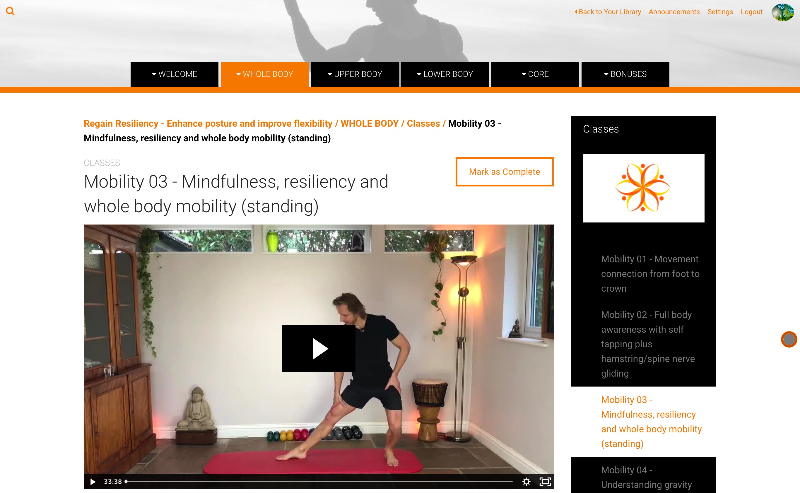
One month of Dojiva for just £30
Get immediate access to all Dojiva classes