Shoulder release - Full length mobility class with Danny
With a combination of good alignment and body awareness, I believe we can all enjoy tension free shoulders.
At the Dojiva Online Studio, we have dozens of classes that focus on the movement, function and strength of your shoulder girdle. This includes the blades to the back, collar bones to the front and many connective tissues all around. Function of this area is very much related to the ball and socket of the shoulder and rotator cuff muscles.
Before you join in for the embodiment… some concepts and philosophy!
Why there’s no need for tension held in the shoulders
I have always been fascinated with the relationship between the shoulders and tension. Shoulders are right near the top of the body and unless we are carrying a back pack, there is nothing above that needs support. So why then do so many people hold tension there? It’s like they’re pushing up into empty space. Shouldn’t the shoulders (and adjoining arms) simply rest on the ribs and everything else beneath?
An example is the roof of your house that is settled nicely with attachments and support from the floors and eventually solid foundations beneath. The roof isn’t supporting anything!
The difference between a house and a human is that our supportive layers are movable and can, over time shift out of place and create tension. To help manage this, we need to strike a balance of suppleness, tone and balanced alignment.
Many of our classes take an alignment journey that travels from feet to head. To help with this, we use sensing (body listening), anatomical imagery and sometimes subtle weight transfer. It can be amazing to compare the difference between the initial sensing (before we even start moving) with sensing at end of the class.
This journey is not only unique to you, but unique to the moment. Which means it’s always fresh and can vary depending on your mental state and what you had been up to the previous day.
The journey of movable support goes something like this (and it’s embodied with our class: Mindfulness 22):
- Our support starts with the ground beneath your feet
- From there we spread our weight over the 26 bones of each foot
- Towards the back of the feet are the larger foot bones, one of which (the tallus) is the support of the main shin bone (the tibia)
- The top of the tibia is a large plateau (platform) on which the long thigh bone rests (the femur)
- The femur heads are shaped like ping-pong balls and along with the sockets of the pelvis (the illiums), these form the hip joint
- To the back of the pelvis we have a third pelvic bone (the sacrum) and that is the direct support of the spine.
- The ribs rest on the spine
- The shoulder girdle which includes the blades, collar bones and shoulder sockets rest on the ribs.
- Finally the head (cranium) rests on the atlas (the first bone of the spine)
We can see from this journey that (with the exception of the head and shoulders) all joints are direct supports of another joint above.
Embodiment
Dojiva qualities such as raising awareness, sound ergonomics, good posture, suppleness and strength need to go beyond the class and beyond the screen. I want you to embody positive movement patterns and notice them filter into real life.
If you sense your body right now, (whether sitting or standing), you might notice that your shoulders do not indeed support anything, yet have great infrastructure beneath. Please pause, even close your eyes for a moment and register this.
That simple piece of information and physical knowing of that information (body awareness) can immediately reduce tensions levels. The shoulders can relax and settle (they can rest on the ribs). Which sounds like a nice little mantra that you could say five times with a smile:
”My shoulders are relaxed and settled”
”My shoulders are relaxed and settled”
”My shoulders are relaxed and settled”
”My shoulders are relaxed and settled”
”My shoulders are relaxed and settled”
A note about throwing
The human shoulder is unique in nature and our mechanics allow for something amazing… the ability to throw! As anatomy goes however, throwing is a very complex move that involves a collaboration of many muscles and joints. It’s the ultimate wholistic and functional movement.
Although ancestrally sound, throwing is not something that most modern humans need to do for survival and it certainly isn’t for everyone (especially with shoulder injuries). It is however used in many sports and of course when throwing a ball for a dog. Also, throwing shares some mechanics with racquet sports and catching.
Your personal desire/need to throw may not be high on your ‘things to learn’ list, but spending time with your arms above your head should not be underestimated. It offers a counter to modern living where most of the time our arms are down and forward of the torso, e.g. typing on a keyboard or holding a steering wheel or even when reading a book. When accompanied with a rounded upper back, we are now officially ‘slouching’!
If you don’t throw, climb, play racket sports or paint ceilings then you may rarely have your arms above your head. And if you tend to sit with poor posture and neglect the flexibility of your chest muscles, then your are asking for future shoulder trouble and unlikely to heal current shoulder injuries. A shoulder imbalance easily sets in as the downward rotators of the shoulder blades become dominant and upward rotators become weak.
Although you may not be planning javelin lessons or spear hunting, many Dojiva classes aim to gradually improve shoulder mechanics for life and sport, reduce shoulder tension and help with posture.
The long term approach
To summarise, the secret to releasing shoulder tension is three fold:
- Embody knowledge that the shoulders are in reality free from burden
- Maintain good alignment so they have great support beneath
- Keep up with flexibility and strength exercise
Without these considerations, no amount of massages and adjustments will pass the test of time and are at best only short term fixes. You need to be involved at every step.
Whether nutrition, mindfulness, strength gains, rehab, weight loss or postural changes, I always encourage a long term approach and today might mark the beginning of a gradual journey to functional, supple, strong and free shoulders. The secret to success is to be patient and consistent.
Ok, that’s all for this blog, keep up to date with me on Youtube for my latest classes.
Thanks for reading
Take care
Danny
Members can login here and for the free ten day Dojiva trial - click here
Train with me online
Private sessions available

For my latest teachings, join the Dojiva membership
It's your online place for restorative movement, functional fitness, relaxation and healthy living
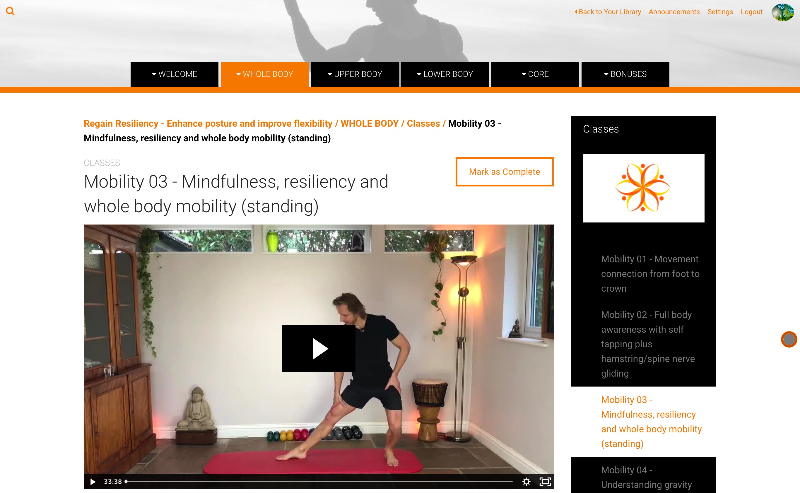
One month of Dojiva for just £30
Get immediate access to all Dojiva classes